
4.4
2,100+ reviews on G2

Color theory is the set of ideas artists use to describe and mix colors and to pick colors that work together: the color wheel, a color's hue, value and chroma, and how colors change each other side by side. You can learn it by painting these four exercises:
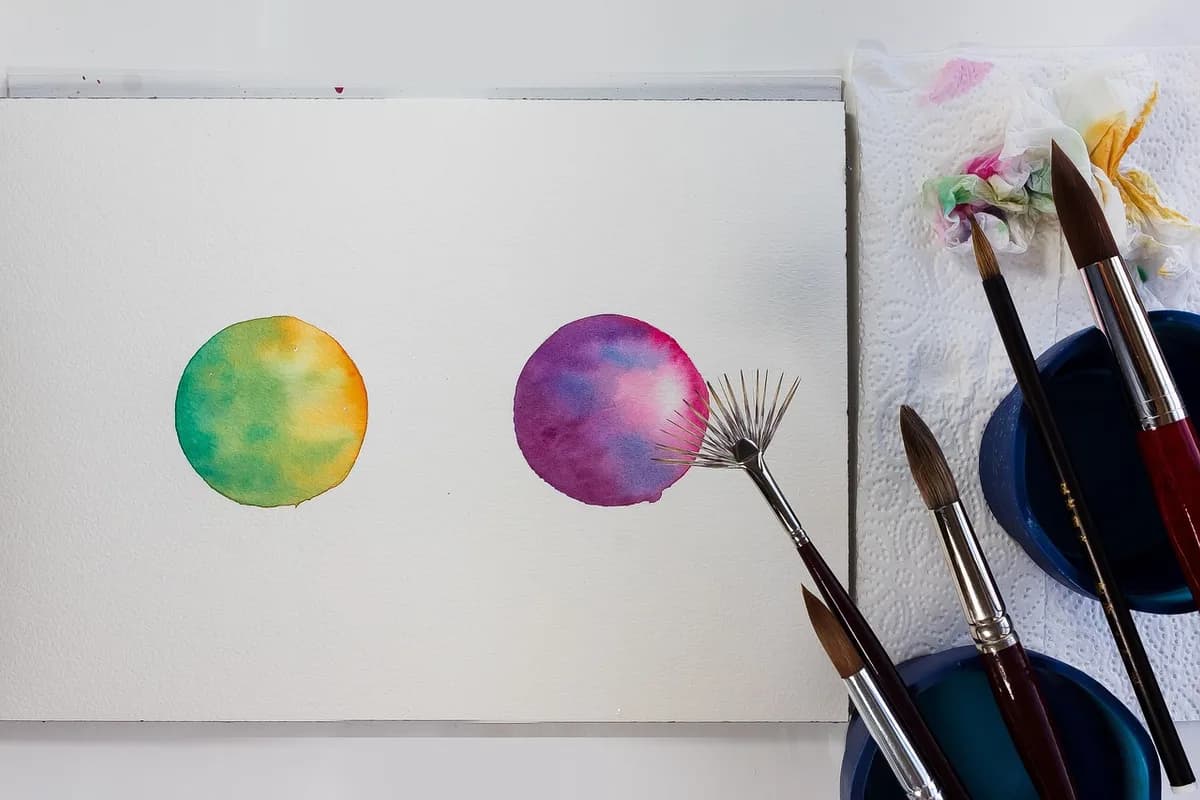
Mix primaries into secondaries and tertiaries.
Steps from white to black, for every color.
Mix opposites into neutrals, step by step.
Paint the same scene in two color schemes.
Keep your practice in Evernote. Photograph every exercise and keep what you learn in one log.
Start with the three painting primaries, red, yellow and blue. Mix each pair into a secondary: orange, green and purple. Then mix each primary with its neighboring secondary for six tertiaries, like yellow-green.
Hue is the color family, like red or blue. Value is how light or dark it is. Chroma, also called saturation or intensity, is how pure and brilliant it looks compared with a dull version.
Paint nine squares from white to black, then do the same with one color by adding white (tints) and black (shades).
Complementary colors sit opposite each other on the wheel. Mix one into the other in small steps: red slowly turning into green passes through browns and a near gray in the middle.
Paint the same gray square on a red background and on a green one. Side by side, complements make each other look stronger. The 19th-century scientist Michel-Eugène Chevreul called this simultaneous contrast.
Paint one simple scene twice: once with analogous colors, neighbors on the wheel, and once with a complementary pair. Compare them and note which you prefer and why.
The words painters and paint makers use, with what each one means in practice.
| Term | What it means |
|---|---|
| Primary | A color that cannot be mixed from other paints. In painting: red, yellow and blue. |
| Secondary | A mix of two primaries: orange, green or purple. |
| Complementary | Two colors opposite on the wheel. Mixed, they make a neutral brown or gray. |
| Hue | The color family, such as yellow, red or blue. |
| Value | How light or dark a color is, compared with white and black. |
| Chroma | Also saturation or intensity: how pure and brilliant a color looks. |
| Tint and shade | A color mixed with white, and a color mixed with black. |
Source: Wikipedia, Color theory.
One entry per session. Copy it, or save it to your Evernote account and add a line each time you practice.
Date: [date] · Minutes: [how long you practiced]
Warm-up: [scales, stretches or drills, about 5 minutes]
Worked on: [piece, song or skill] · Part: [bars, verse or exercise]
Measure: [tempo, number of clean run-throughs, or pages filled]
Fix next time: [one thing, as specific as you can]
Recording or photo: [voice note or photo of today]
4.4
2,100+ reviews on G2

4.4
8,200+ reviews on Capterra

4.4
73,000+ reviews on App Store

248M
Registered users

The color wheel (primaries, secondaries and tertiaries), the three properties of a color (hue, value and chroma), complementary colors, and color schemes such as analogous and complementary.
Red, yellow and blue. In theory you could mix every color from them; in practice no set of three paints mixes every color, so painters add a few more.
Colors opposite each other on the color wheel, such as red and green, blue and orange, and yellow and purple. Side by side they look more intense; mixed, they make neutrals.
A tint is a color plus white, a shade is a color plus black, and a tone is a color plus gray, which lowers its chroma.
How light or dark a color is. A value scale from white to black helps you judge it, and squinting at your subject shows the big light and dark shapes.
The terms are quick to learn. Using them well comes from mixing: short exercises like a color wheel, value scales and complement mixes build a feel for it.
Screens mix light, so their primaries are red, green and blue, not red, yellow and blue. Value, contrast and color schemes work the same way.
Keep an art notebook with one note per exercise and one practice log note with a table.
Open a note for today's exercise, write which paints you used, and add a photo of the finished swatches.
Ask the AI Assistant to add today's session to your log note. It reads today's note and adds a row with the date, what you worked on, the minutes and the exercise and paints.
Ask the Assistant to chart how many exercises you finished each week from the log. It adds a chart to the top of the note, so you can see the trend week by week.
Record or photograph each practice session, log it in one table with the AI Assistant, and chart your progress week by week.
Start for free