
4.4
2,100+ reviews on G2

Music theory explains how music is built: the notes and how they are written, rhythm and meter, scales and keys, intervals, and the chords made from them. Learn it in this order, on an instrument:
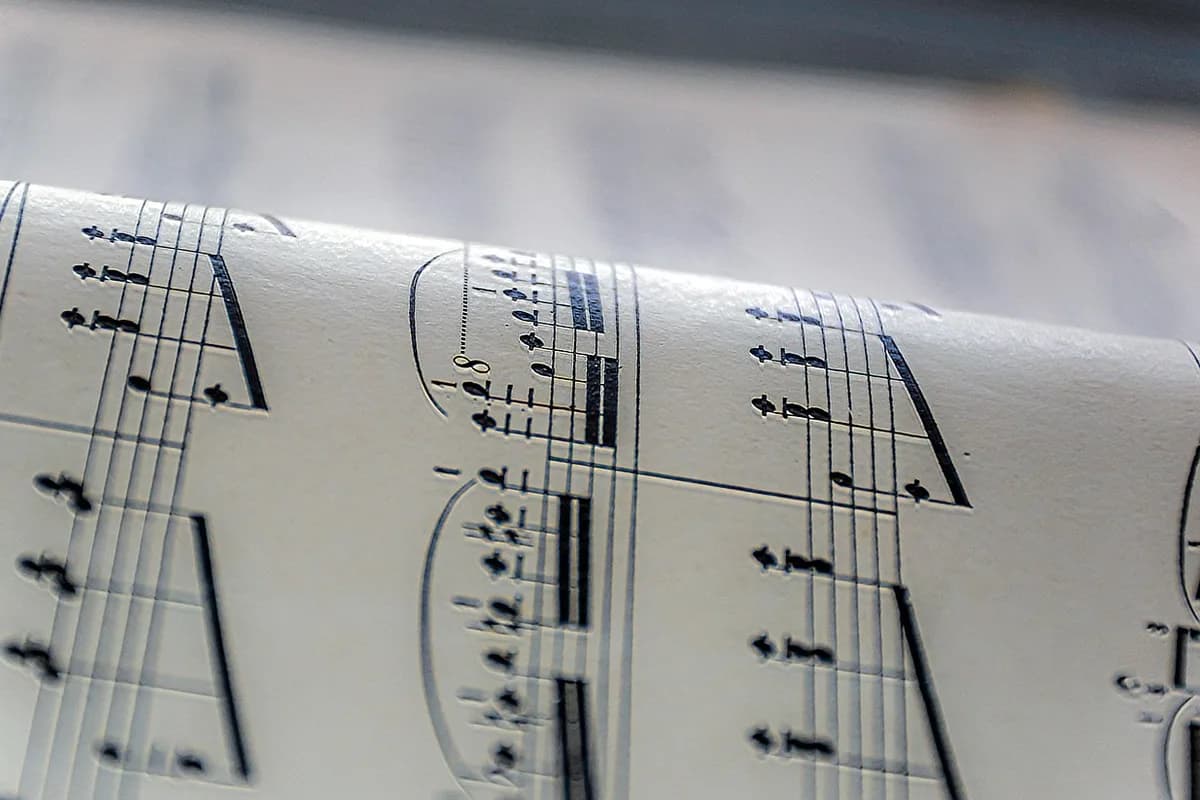
Letter names A to G, clefs and ledger lines.
Note values, beats and time signatures.
The major scale pattern of whole and half steps.
Stack thirds into triads, then progressions.
Keep your practice in Evernote. Record each session, log it, and chart your progress.
Music uses seven letters, A to G, on a five-line staff. Learn the treble clef (lines E, G, B, D, F; spaces F, A, C, E) and the bass clef (lines G, B, D, F, A; spaces A, C, E, G).
The top number of a time signature is how many beats are in each measure, and the bottom number is the note that gets one beat. Count and clap simple rhythms in 4/4 and 3/4.
A major scale follows the pattern whole, whole, half, whole, whole, whole, half. It uses every letter once, in order. C major has no sharps or flats.
An interval is the distance between two notes. Count letter names to name it: C up to E is a third, C up to G a fifth. Sing or play each one as you learn it.
Stack two thirds on a note to build a triad: C, E, G is C major. Build one on every note of the scale. In a major key, chords I, IV and V are major, and ii, iii and vi are minor.
Play I, IV, V, I in a few keys, then look up the chords of songs you know and label them with Roman numerals. Theory sticks when you hear it.
| Scale note | Step to next | Triad | Chord |
|---|---|---|---|
| 3C (1) | Whole | C, E, G | I, C major |
| D (2) | Whole | D, F, A | ii, D minor |
| 4E (3) | Half | E, G, B | iii, E minor |
| 5F (4) | Whole | F, A, C | IV, F major |
| G (5) | Whole | G, B, D | V, G major |
| A (6) | Whole | A, C, E | vi, A minor |
| B (7) | Half | B, D, F | vii°, B diminished |
| 6Progression | C, F, G, C | I, IV, V, I |
Pattern of whole and half steps from the University of Puget Sound music theory text.
Each scale keeps the same pattern of whole and half steps. Starting on a new note means adding sharps or flats to keep it.
| Key | Notes | Sharps or flats |
|---|---|---|
| C major | C D E F G A B C | None |
| G major | G A B C D E F♯ G | 1 sharp: F♯ |
| D major | D E F♯ G A B C♯ D | 2 sharps: F♯, C♯ |
| F major | F G A B♭ C D E F | 1 flat: B♭ |
| B♭ major | B♭ C D E♭ F G A B♭ | 2 flats: B♭, E♭ |
One entry per session. Copy it, or save it to your Evernote account and add a line each time you practice.
Date: [date] · Minutes: [how long you practiced]
Warm-up: [scales, stretches or drills, about 5 minutes]
Worked on: [piece, song or skill] · Part: [bars, verse or exercise]
Measure: [tempo, number of clean run-throughs, or pages filled]
Fix next time: [one thing, as specific as you can]
Recording or photo: [voice note or photo of today]
4.4
2,100+ reviews on G2

4.4
8,200+ reviews on Capterra

4.4
73,000+ reviews on App Store

248M
Registered users

With reading notes on the staff and basic rhythm. Then learn the major scale, intervals and triads, and practice each idea on an instrument so you hear it.
Whole, whole, half, whole, whole, whole, half. On a piano, a whole step skips one key and a half step goes to the very next key, black or white.
The distance between two notes. Count letters from the lower note up, counting both ends: C to E is a third (C, D, E).
A three-note chord built from a root, a third and a fifth, such as C, E, G. Major and minor are two of the four triad types.
Roman numerals for chords built on the 1st, 4th and 5th notes of a scale. In C major, I, IV, V is C, F and G. Capital numerals are major chords; lowercase are minor.
No, but it helps. It makes songs quicker to learn, helps you write your own, and lets you talk to other musicians about chords and keys.
You can learn the terms from a book, but theory sticks when you play or sing it. A cheap keyboard or a piano app is enough.
Keep a theory notebook with one note per topic and one practice log note with a table.
Open a note for today, write the scale or chords you worked on, and add a voice note of you playing them.
Ask the AI Assistant to add today's session to your log note. It reads today's note and adds a row with the date, what you worked on, the minutes and the keys you practiced.
Ask the Assistant to chart how many keys you can play by week from the log. It adds a chart to the top of the note, so you can see the trend week by week.
Record or photograph each practice session, log it in one table with the AI Assistant, and chart your progress week by week.
Start for free