
4.4
2,100+ reviews on G2

Writing a script means turning a story into scenes of action and dialogue, laid out in a fixed format that actors and crews can work from: a scene heading, what we see, and who says what. A movie script comes together in four stages:
The story in one sentence: who wants what, and why it is hard.
Three acts, or connected sequences.
Every scene in order, before you write dialogue.
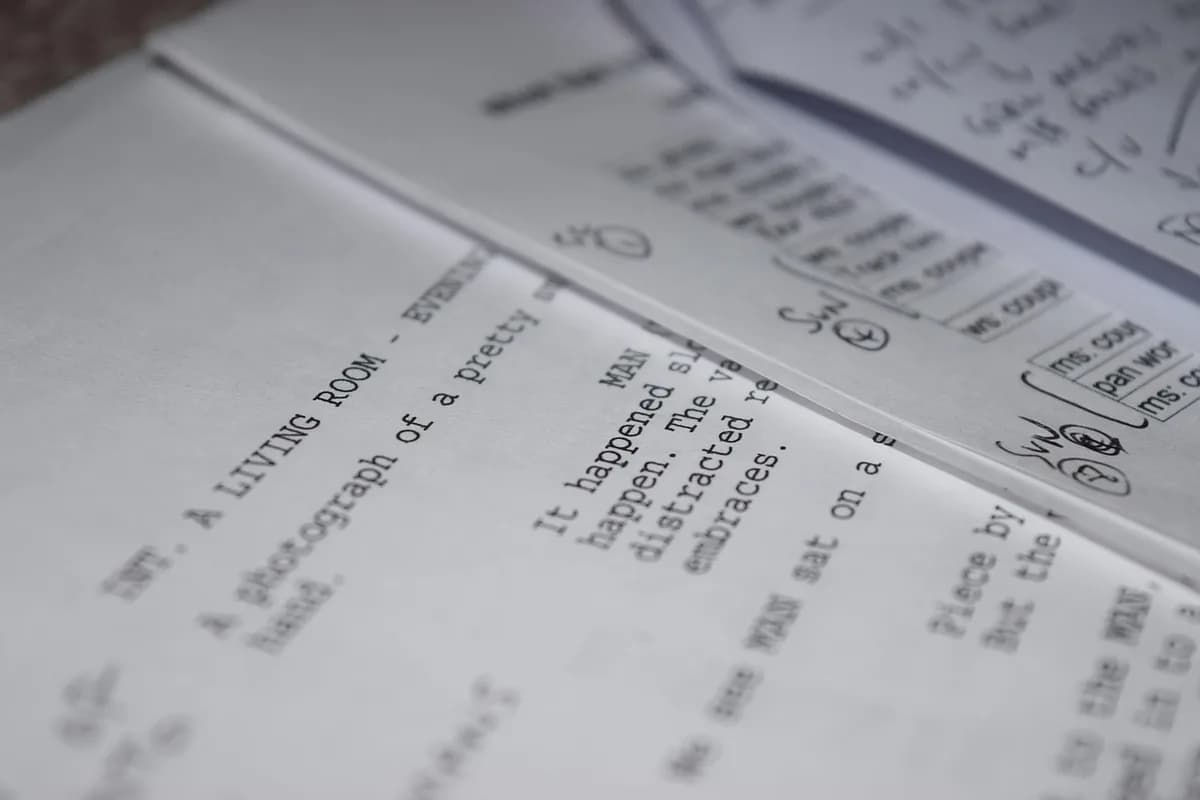
12 pt Courier, headings, action, names, dialogue.
Write your script in Evernote. One note per scene, a plot timeline, then a rough scene in script format.
One sentence: the main character, what they want, what stands in the way. If you cannot say it in a sentence, the story is not clear yet.
The classic film structure has three acts: set-up, conflict and resolution. Another way is a series of connected sequences, each a small story leading to the next.
Write one line per scene: where it is, when, and what changes. Move the lines around before you write the pages.
Interior or exterior, the place, then the time of day, in that order, in capitals: EXT. PLATFORM 4 - NIGHT.
Describe only what we can see and hear. The first time a character appears, write their name in capitals.
The character's name in capitals, centered above the line. A short direction in parentheses goes on its own line under the name. Dialogue has no quote marks.
A script is a technical document, and 12-point Courier is the standard. Read the draft out loud, cut what does not move the story, and rewrite.
4EXT. PLATFORM 4 - NIGHT
5MAYA, 20s, runs back down the stairs. The station clock reads 12:52. She checks her phone: 1:06.
6MAYA
That clock is wrong!
THEO
(smiling)
Since 1987.
CUT TO:
Set in Courier, the standard script typeface.
Every line on a script page is one of these. Script software uses this set, including the transition line that moves us to the next scene. You can ask the AI Assistant to lay out a scene in this format.
| Element | What it is | Example |
|---|---|---|
| Scene heading | Interior or exterior, place, time of day | EXT. PLATFORM 4 - NIGHT |
| Action | What we see and hear, in the present tense | Maya runs back down the stairs. |
| Character | Name in capitals above the dialogue | MAYA |
| Parenthetical | A short direction under the name | (smiling) |
| Dialogue | What the character says, no quote marks | That clock is wrong! |
| Transition | How we move to the next scene | CUT TO: |
Based on the New York Film Academy's guide to script structure and format.
Copy it, or save it to your Evernote account and give each scene its own note.
Title: [working title] · Format: [feature, short, play, video, TV episode]
Logline: [main character] wants [goal], but [obstacle], so [what they must do].
Act 1, set-up: [who, where, what normal looks like] · Turning point: [event]
Act 2, conflict: [what gets in the way] · Midpoint: [reversal]
Act 3, resolution: [climax] · [how it ends]
Scene list: 1. [INT. or EXT. place - DAY or NIGHT] [what happens] 2. [ ] 3. [ ]
4.4
2,100+ reviews on G2

4.4
8,200+ reviews on Capterra

4.4
73,000+ reviews on App Store

248M
Registered users

With a logline and a scene list. Once you know who wants what and the order of scenes, write the first draft scene by scene in script format.
12-point Courier. Each scene starts with a heading (interior or exterior, place, time of day), then action in the present tense, then dialogue under each character's name in capitals.
A one-sentence summary of the story: the main character, their goal and what stands in the way. Writers use it to test whether the story is clear.
Put the character's name in capitals, centered, then the line below it without quote marks. Add a short direction in parentheses under the name only when it changes how the line is read.
The page format is similar, but a TV script is shaped around breaks, with a teaser and acts that each end on a moment that keeps viewers watching. Film scenes can run longer and uninterrupted.
None to start. You can outline and draft in any notes app, as long as the final pages follow script format. Dedicated script software handles margins for you.
It depends on the format. Plan scene by scene and cut anything that does not move the story; a short film can be a handful of pages.
Keep one notebook for the script: an outline note, one note per scene, and your research.
Write the scene list in one note, then ask the AI Assistant to create a note for each scene and link them from the outline. Each scene opens with one click.
Ask the Assistant to add a timeline of the plot from your scene notes. It reads the notes and draws the timeline at the top of the outline.
Write the scene roughly in plain sentences, then ask the Assistant to format it as a screenplay. It edits the note in place, and you accept or reject each change.
Keep your outline and drafts in Evernote, let the AI Assistant draw the structure as a timeline, and turn the rough draft into script format.
Start for free