
4.4
2,100+ reviews on G2

A character's thoughts, or internal dialogue, are the inner voice you show on the page, either woven into the narration or set off as direct thought, in italics or quotation marks. Writing them well comes down to four choices:
The exact words in her head, or the narration telling us what she thinks.
Fiction can use italics or quotation marks for direct thought; italics separate thought from speech.
"She thought" is optional when the point of view is clear.
Pick one style for the book and keep it.
Write your book in Evernote. The AI Assistant turns your notes into a style sheet and checks one chapter.
Thoughts belong to the point-of-view character of the scene. If you show two characters' thoughts in one scene, the reader loses track of whose story it is.
Indirect thought stays in the narration's person and tense ("Would a knife be enough? He didn't know."). Direct thought gives the character's own words in first person, often present tense ("I have my knife.").
Fiction may use italics or quotation marks for direct thought. Italics separate thought from speech at a glance.
Add "he thought" when it isn't clear who is thinking. In close third person or first person, the thought usually needs no tag.
Write down the style you chose and apply it in every chapter. If you work with a publisher, the house style guide decides in the end.
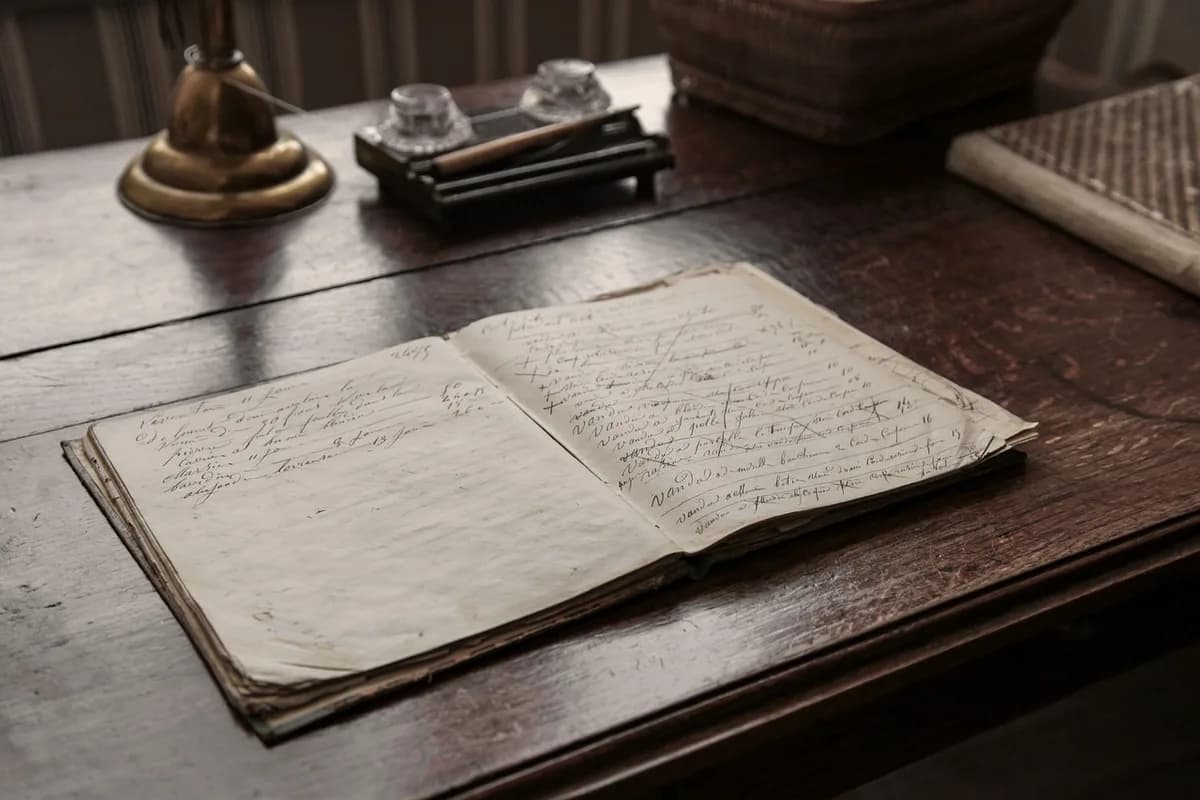
1Indirect: Mara stood at the window. The logbook lay open on the table. Had her father really written that entry? She couldn't be sure.
2Direct, no tag: Mara stood at the window. I know that handwriting. I have known it all my life.
3Direct, set in italics in the book (shown here as plain text): Mara stood at the window. I know that handwriting.
4Direct, with a tag: I know that handwriting, she thought, and turned away from the window.
Any of these is correct. Choose one that fits your voice, and keep it for the whole book.
| Style | Example | When it works |
|---|---|---|
| Indirect thought | Would a knife be enough? He didn't know. | Close third person, smooth reading |
| Direct thought in italics | I should leave tonight. | Short, important thoughts that need to stand out |
| Direct thought, no italics | I should leave tonight, he thought. | Books with a lot of inner voice, where italics would crowd the page |
| Quotation marks | She thought, "I should leave." | Fiction that uses them, and essays that quote them |
Sources: MLA Style Center, "Styling internal thoughts"; Elizabeth Sims on internal dialogue, via Jane Friedman; Writer's Digest, "How Do You Style a Character's Thoughts".
Copy it, or save it to your Evernote account and keep it next to your chapters.
Point of view: [first person / close third / several narrators]
Direct thought: [italics / plain text]
Tense of direct thought: [present / past]
Tags: [use "she thought" only when / never / always]
Exceptions: [dreams, memories, telepathy...]
4.4
2,100+ reviews on G2

4.4
8,200+ reviews on Capterra

4.4
73,000+ reviews on App Store

248M
Registered users

It is the most accepted way to set off direct thought in fiction, because italics separate thought from speech. Plain text is another option. Either works if you are consistent.
In fiction, you can use quotation marks for thoughts, but make clear they are thoughts, not speech. When you quote a character's thoughts in an essay about a book, use quotation marks.
The inner voice of a character on the page. It shows what they think as opposed to what they say or do, and it is one of the main ways readers get to know a character.
Only when it isn't clear whose thought it is. In close point of view, a direct thought usually stands on its own.
The whole narration is already the narrator's voice, so most thoughts need no formatting. Use italics only for a sudden, exact thought you want to stand out.
Direct thought can be in the present tense, even in a past-tense novel, because it gives the character's exact words at that moment.
Keep a style sheet and one note per character next to your chapters, so the Assistant can check them for you.
Keep a style sheet and one note per character next to your chapters. Ask the AI Assistant for a thought-style plan from them, with a timeline of the styles you use.
Ask the Assistant where a chapter uses a tag, italics or a quotation mark for thought. It cites the lines, so you can make the chapter match the style sheet.
Ask it to add a task such as "check one chapter for thought style every weekday at 7 AM". The task repeats and reminds you each morning.
Outline from your own notes, check any detail across every chapter, and get a reminder to write each day.
Start for free