Compress PDF to 1mb

About us
English
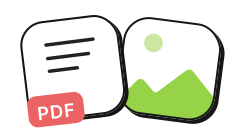
Compress PDF to 1mb
Compress PDF to 1mb quickly with Evernote's online compressor while keeping document clarity
or drag and drop a file
Supports images and PDFs (max 100MB)
By using the product, you agree to our Terms of Service and have read our Privacy Policy.
Trusted by Millions Worldwide
4.4
2,100+ reviews on G2
4.4
8,200+ reviews on Capterra
4.4
73,000+ reviews on App Store
248M
Registered Users
5B
Notes Created
2M
Notes Created Daily





Frequently Asked Questions
Compressing a PDF to 1MB means reducing the file’s data so its total size is around one megabyte. The process reduces image resolution, optimizes embedded resources, or removes unnecessary file overhead to make the document smaller. Evernote’s online tool focuses on shrinking file size while preserving readability and layout so the PDF remains usable for sharing and storage.
Compressing PDFs makes them easier to share by email, upload, or store on devices with limited space. Smaller files load faster and use less bandwidth. Compression is especially helpful when you need to meet attachment limits or speed up transfers. Evernote’s compressor is designed to reduce file size quickly and for free while keeping documents legible for common uses.
Evernote’s online compressor reduces PDF size by optimizing the file’s content and structure. It focuses on compressing image data and trimming unnecessary file overhead while preserving document layout and text clarity. The tool runs in your browser, so you can shrink files quickly without installing software. The goal is to balance reduced size with preserved quality for convenient sharing and storage.
Compression can affect visible quality depending on how much a file is reduced. Minor reductions often have negligible visual impact, while aggressive compression may reduce image detail or subtle typographic elements. Evernote’s compressor aims to preserve legibility and layout, but very large or image-heavy PDFs may show more noticeable changes if pushed down to 1MB.
Not every PDF can reach 1MB without a noticeable loss in quality. Files with many high-resolution images, complex graphics, or embedded media might only shrink so far before clarity suffers. The final size depends on the original content and desired quality. If a PDF contains mostly scanned high-resolution images, reaching 1MB could require significant visual compromises.
Some online tools support batch compression while others handle one file at a time. If you need to compress many PDFs, check the Evernote compressor interface for batch options or process files sequentially. When working with multiple documents, consider testing settings on one file first to confirm the quality output before applying the same approach to a larger group.
Achieving an exact 1MB target consistently can be difficult because compression results depend on file contents and formatting. Tools typically aim for a size range rather than an exact byte count. You can try different compression settings or incremental adjustments, but expect some variability. If an exact size is required, you may need to combine compression with manual edits like removing pages or lowering image resolution.
Undoing compression usually requires keeping the original file. Many workflows recommend saving a copy of the original PDF before compressing, so you can revert if quality loss is unacceptable. If you overwrite the original and don’t have a backup, you can’t reliably restore the pre-compressed version from the compressed file alone. Always save a separate copy when testing compression levels.
Most online compressors accept a broad range of PDF sizes, from small documents to many megabytes. Specific limits vary by tool and browser capabilities, so check the Evernote compressor interface for any maximum file size notes. For very large PDFs, breaking the document into smaller parts or using a higher-bandwidth connection can make upload and compression faster.
If a PDF already contains selectable, embedded text, compression typically preserves that text and keeps the document searchable. Compression mainly targets image and resource data, so text layers remain intact in most cases. For image-only PDFs created from scans, compression affects the images; to preserve searchability you may need OCR before or after compression.
Compression usually completes in seconds to a few minutes depending on the original file size, complexity, and your internet speed. Smaller documents process very quickly, while large or image-heavy PDFs can take longer to upload and compress. Evernote’s online tool is designed to operate quickly in modern browsers to minimize wait times.
Yes, the Evernote online PDF compressor is offered as a free tool to reduce file size quickly and conveniently. It’s accessible through a web browser so you can compress PDFs without installing software. For specific feature availability or any account-based capabilities, check the Evernote tool page for the latest details.
Compression normally reduces image resolution or adjusts image quality rather than removing images entirely. Some tools offer settings that can downsample or strip certain embedded elements, but images are usually preserved in a smaller form. If you want images removed entirely, you would need to edit the PDF to delete them before compression.
Yes. Because Evernote’s compressor runs in a web browser, you can typically compress PDFs from a modern mobile browser on smartphones and tablets. Performance may vary by device and connection, so for very large files a desktop connection may be faster. Always save a copy of the original before compressing on any device.
The main risk is losing image detail or subtle typographic clarity if compression is too aggressive. Compression can also change file structure in ways that affect very specific workflows, such as print reproduction or high-precision archival uses. To avoid unwanted results, test compression on a copy of your PDF and compare the compressed output to ensure it meets your needs.