Merge and split PDF

About us
English

Merge and split PDF
Merge and split PDF files quickly — combine, reorder, and split pages with Evernote
or drag and drop a file
Supports PDF files (max 100MB each, up to 10 files)
By using the product, you agree to our Terms of Service and have read our Privacy Policy.
Trusted by Millions Worldwide
4.4
2,100+ reviews on G2
4.4
8,200+ reviews on Capterra
4.4
73,000+ reviews on App Store
248M
Registered Users
5B
Notes Created
2M
Notes Created Daily











Frequently Asked Questions
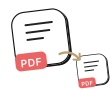
Merge and split PDF lets you combine separate PDF documents into a single file, reorder pages, and split a PDF into smaller files or page ranges. In one simple tool offered through Evernote, you can manage page-level operations without opening a full PDF editor. It’s focused on putting common page tasks—combine, reorder, and split—together so you can prepare PDFs for sharing, archiving, or attaching to your notes.
This tool is useful for anyone who needs quick PDF page management: students compiling lecture notes, professionals assembling reports, or anyone organizing scanned documents. If you already use Evernote for note-taking and project work, merging and splitting PDFs in the same ecosystem helps keep documents organized alongside your notes and reference materials.
Yes — the page operations to combine, reorder, and split pages are available for free with Evernote. The tool focuses on these basic PDF tasks so you can manage document pages without needing separate software. If you use Evernote regularly, this capability is provided as a convenient part of your workflow.
To combine PDFs, upload the files you want to merge into the Merge and split PDF tool. Arrange the documents and individual pages into the order you want, then choose the option to create a single PDF. The tool produces a new PDF that contains the pages in the sequence you set, which you can then save, download, or keep with your Evernote content.
Upload the PDF you want to split, then select the page ranges or individual pages you want to separate. Use the split options to extract those pages into a new PDF or create several smaller PDFs based on ranges. The interface focuses on page-level selection so you can pull out single pages, groups of pages, or break a long document into multiple files.
You can combine multiple PDFs into one document, reorder individual pages before saving, and split a PDF into new files by selecting pages or page ranges. The tool centers on page-level tasks rather than editing text or images inside a PDF, making it a fast way to restructure and assemble documents for notes, sharing, or filing.
Merged PDFs generally retain the original page layout and formatting because the tool combines pages as they appear in the source files. That means fonts, images, and page design are preserved as static pages in the new document. The focus is on maintaining the visual integrity of each page rather than altering content within pages.
This tool is designed for PDF files. Upload PDF documents that you want to combine, reorder, or split. Since the operations work at the page level, the tool expects PDF inputs and creates PDF outputs suitable for storing with your notes or sharing as standalone documents.
Yes. You can upload multiple PDF files and combine them into a single document. After uploading, arrange the order of files and pages as needed, then select the option to create one merged PDF. The resulting file will contain all selected pages in the sequence you specified.
Yes. Reordering pages is part of the merging process. After you upload documents, drag and drop pages or files into the desired order. Once you confirm, the tool creates a merged PDF that reflects that page order. This makes it easy to assemble a single document from multiple sources while controlling how content flows.
Yes. The split feature lets you select specific pages or ranges to extract into a new PDF. You can pull out single important pages, create smaller documents from a larger file, or build custom PDFs containing only the sections you need. The process focuses on selecting the pages you want and exporting them as a separate PDF.
Yes. Evernote provides a consolidated workflow for these page operations so you don’t need separate tools for each task. By combining merge and split features in one interface, Evernote helps you prepare PDFs quickly and keep the resulting files organized alongside your notes and projects.
This tool emphasizes page-level management—combining, reordering, and splitting—rather than in-depth editing of text or images inside a PDF. For detailed content editing, annotate, or extensive modifications, you can use other Evernote features or dedicated PDF editors in combination with your merged or split files. The Merge and split PDF tool is optimized for restructuring documents.
Limits can vary by environment, and very large files or extremely long documents may be best handled in batches. The Merge and split PDF tool is aimed at typical page-management tasks; if you work with very large archives, consider splitting them into smaller jobs to ensure smooth processing. Evernote’s workflow helps keep the results accessible alongside your notes.
Yes. Scanned PDFs, which are stored as page images, can be combined, reordered, and split just like other PDFs. Because the tool operates at the page level, scanned pages are treated the same as regular PDF pages. If you need text recognition for scanned content, use Evernote’s other tools or a separate OCR workflow alongside your merged or split files.