Split PDF by page

About us
English

Split PDF by page
Split PDF by page — extract single pages or page ranges into separate files with Evernote
or drag and drop a file
Supports PDF files (max 100MB each, up to 10 files)
By using the product, you agree to our Terms of Service and have read our Privacy Policy.
Trusted by Millions Worldwide
4.4
2,100+ reviews on G2
4.4
8,200+ reviews on Capterra
4.4
73,000+ reviews on App Store
248M
Registered Users
5B
Notes Created
2M
Notes Created Daily











Frequently Asked Questions
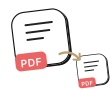
Splitting a PDF by page means dividing a multi-page PDF into separate files, each containing one or more pages from the original. You can extract individual pages or select a page range to create new documents. Evernote's split tool lets you choose which pages to extract, then produces separate PDF files you can download or save to your notes for further use.
Splitting a PDF by page helps you share, store, or work with only the pages you need without sending the entire document. It’s useful for extracting forms, receipts, chapters, or specific sections for review. With Evernote, you can quickly isolate relevant pages and keep them organized in notes or as separate files for collaboration, printing, or archiving.
Anyone who regularly works with PDF documents can benefit from splitting files by page: students, administrative staff, project teams, and anyone organizing digital documents. Evernote’s tool is designed for people who need quick, straightforward extraction of pages or ranges, enabling efficient sharing, focused review, and easier document management without altering the original file.
To split by a page range, upload the PDF, then specify the start and end pages for the section you want to extract. The tool will create a new PDF containing only those pages. You can repeat the process for multiple ranges in the same document. Evernote’s interface typically shows page numbers and allows you to input ranges like 2-5 or select pages visually before exporting.
Splitting a PDF by page generally preserves the original content quality, including images and text, because the operation extracts existing pages rather than re-rendering them. Evernote’s split tool focuses on keeping the page data intact so the resulting files maintain readable text and image clarity. If you plan to edit or convert pages afterward, format changes may occur depending on subsequent actions.
When you split a PDF by page, the output is typically new PDF files containing the chosen pages or ranges. These files are compatible with standard PDF viewers and can be downloaded, attached to notes, or saved elsewhere. Some workflows also allow exporting images of pages if you need individual page images, but the primary outcome from a split operation is a standard PDF document.
Page numbers within the content remain as they appear on the original pages; splitting does not renumber embedded page headers or footers. The new file’s internal page order starts at its first extracted page, but any visible page numbers printed on the pages will reflect the original numbering. If you need updated page headers, you can add or edit them after splitting using a PDF editor or in Evernote notes.
Yes. PDFs that include images or scanned pages can be split by page just like text-based PDFs. The split operation extracts the page data 그대로, so image-based pages remain images in the new files. If optical character recognition (OCR) is required for searchable text, that typically happens as a separate step; splitting itself retains whatever content type exists on each page.
Yes. Evernote’s web-based tools and mobile-friendly interfaces allow you to upload and split PDFs from phones and tablets. The process mirrors desktop steps: choose the file, select pages or ranges, and create separate files for download or to save in your notes. Mobile performance may vary with file size, so ensure a stable connection and enough device storage for the output files.
Batch-splitting multiple PDFs may be supported depending on the tool’s capabilities. Some workflows let you upload several files and apply split settings to each, while others focus on one document at a time. With Evernote, you can process files and save resulting pages to your notes, then repeat quickly. For large batches, consider preparing a list of page ranges and processing files in sequence for consistent results.
Yes. A preview is helpful to confirm the exact pages you want to extract. Evernote’s interface typically provides a page view so you can visually select pages or enter ranges with confidence. Previewing ensures you avoid extracting the wrong pages and helps you verify page order and content before creating and downloading the new files.
After splitting, you can download the new PDF files to your device or save them directly into Evernote as notes or attachments if you prefer to keep everything organized in one place. Saving to Evernote makes it easy to tag, search, and combine split pages with related notes. Use the save or export options available after the split completes to choose where to store your files.
Many tools impose file size or upload limits to ensure smooth performance, and this can affect very large PDFs. If you encounter limits, try splitting the document into smaller ranges or process it in parts. Evernote’s workflow encourages manageable uploads and gives options to extract pages incrementally so you can handle large documents without needing to process the entire file at once.
Annotations and bookmarks that are embedded in the original pages are often retained when those pages are extracted, since splitting preserves page content. However, some metadata or interactive elements may behave differently when moved into a new file, and bookmarks that referenced positions across the original document may need adjustment. After splitting, you can check and update annotations or bookmarks as needed in a PDF editor or within Evernote notes.