Split PDF on iPhone

About us
English

Split PDF on iPhone
Split PDF on iPhone from your browser and organize pages with Evernote
or drag and drop a file
Supports PDF files (max 100MB each, up to 10 files)
By using the product, you agree to our Terms of Service and have read our Privacy Policy.
Trusted by Millions Worldwide
4.4
2,100+ reviews on G2
4.4
8,200+ reviews on Capterra
4.4
73,000+ reviews on App Store
248M
Registered Users
5B
Notes Created
2M
Notes Created Daily











Frequently Asked Questions
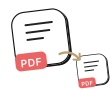
Splitting a PDF on iPhone creates one or more new PDF files from an original document. You can extract single pages, create files for page ranges, or separate sections for sharing or archiving. Evernote's browser-based tools let you handle these tasks directly on your device without installing extra apps, then save or attach the resulting PDFs to notes, send them via email, or store them in Files.
Evernote combines simple browser-based PDF splitting with note organization so you can keep split files alongside related notes, annotations, and tags. The workflow is designed for mobile convenience: upload or open a PDF, choose pages or ranges to split, and save results directly to your Evernote account or download them to your iPhone. This keeps documents accessible and organized in one place.
Open the PDF split tool in your browser or via Evernote, then upload or select the PDF stored on your iPhone. Choose the pages or ranges you want to extract, preview the selection, and confirm the split. After processing, download the new files, save them to Evernote, or share them using the iOS share sheet. The interface guides you through selecting pages and saving outputs.
Yes. The tool lets you specify exact page ranges to extract from a PDF, for example pages 3–7 or 10–12. You can create multiple new files from different ranges in a single workflow where supported, or repeat the process for each range. After splitting, name and save each output file to Evernote or your device for easy reference and further organization.
Batch processing capabilities vary by tool. Many browser-based workflows handle one PDF at a time, so for multiple documents you may repeat the split steps for each file. Evernote makes it easy to save and organize every split result in your account, so even if you process files individually you can collect and tag them consistently for later retrieval.
The splitting workflow is built for standard PDF files. If your document is in another format, convert it to PDF before using the split tool. Common PDF variants—including linearized or standard multi-page PDFs—are typically supported. If a file type causes an issue, saving or exporting it as a regular PDF on your iPhone first usually resolves compatibility problems.
Scanned or image-based PDFs can usually be split just like text PDFs because splitting separates pages rather than modifying content. If you need searchable text after splitting, use Evernote’s OCR features in notes or another OCR step to extract searchable text. The split operation itself preserves the visual content of scanned pages.
After splitting, you can download files to your iPhone, save them to Files, or attach them to Evernote notes. Many tools auto-name outputs by adding page ranges or sequence numbers to the original filename; you can rename files before saving or rename them later in Evernote. This helps keep split documents identifiable and organized alongside related notes.
Some browser-based tools and mobile environments may have practical limits for very large files or extremely long documents, which can affect upload and processing time. If you encounter limits, splitting the document into smaller chunks or working with smaller page ranges can help. Evernote supports saving the resulting files to your account for continued organization and access.
Yes. You can select one page and extract it as a separate PDF for quick sharing. After extraction, use the iOS share sheet to send the single-page PDF via email, message, AirDrop, or save it directly into Evernote. Extracting a single page is useful for sending specific content without sharing the entire document.
Splitting a PDF preserves the original page content and quality because the operation separates pages rather than re-rendering images or text. Visual quality, layout, and embedded graphics remain intact. Metadata and annotations are generally retained with the associated pages, though behavior can vary by PDF type. The tool focuses on keeping the original fidelity of each page.
Yes. After splitting, you can reorder pages or combine files using merge and arrange features where available. Save split files to Evernote or Files and then use a merge workflow to assemble the pages in the order you need. This lets you fine-tune documents after separating them, creating custom PDFs from selected pages.
Once a PDF is split, download it to your iPhone or save it to Evernote. Use the Files app to open the PDF in any compatible viewer, or tap the share icon to send it via email, message, AirDrop, or other apps. You can also attach split PDFs directly to Evernote notes for easy access and sharing from within Evernote on any device.
Splitting itself does not typically perform OCR; it separates pages while preserving their visual content. If you need searchable text, use Evernote’s OCR capabilities after saving the split files into your Evernote notes or run a separate OCR step with a dedicated tool. That approach provides searchable text while keeping the split files intact.
If a PDF fails to split, first check the file for corruption by opening it in a viewer. Try exporting or re-saving it as a standard PDF on your iPhone, then attempt splitting again. For very large files, split into smaller ranges, or try a different browser session. If issues persist, save the file to Evernote and use alternate workflows there to extract needed pages or contact Evernote support for guidance.